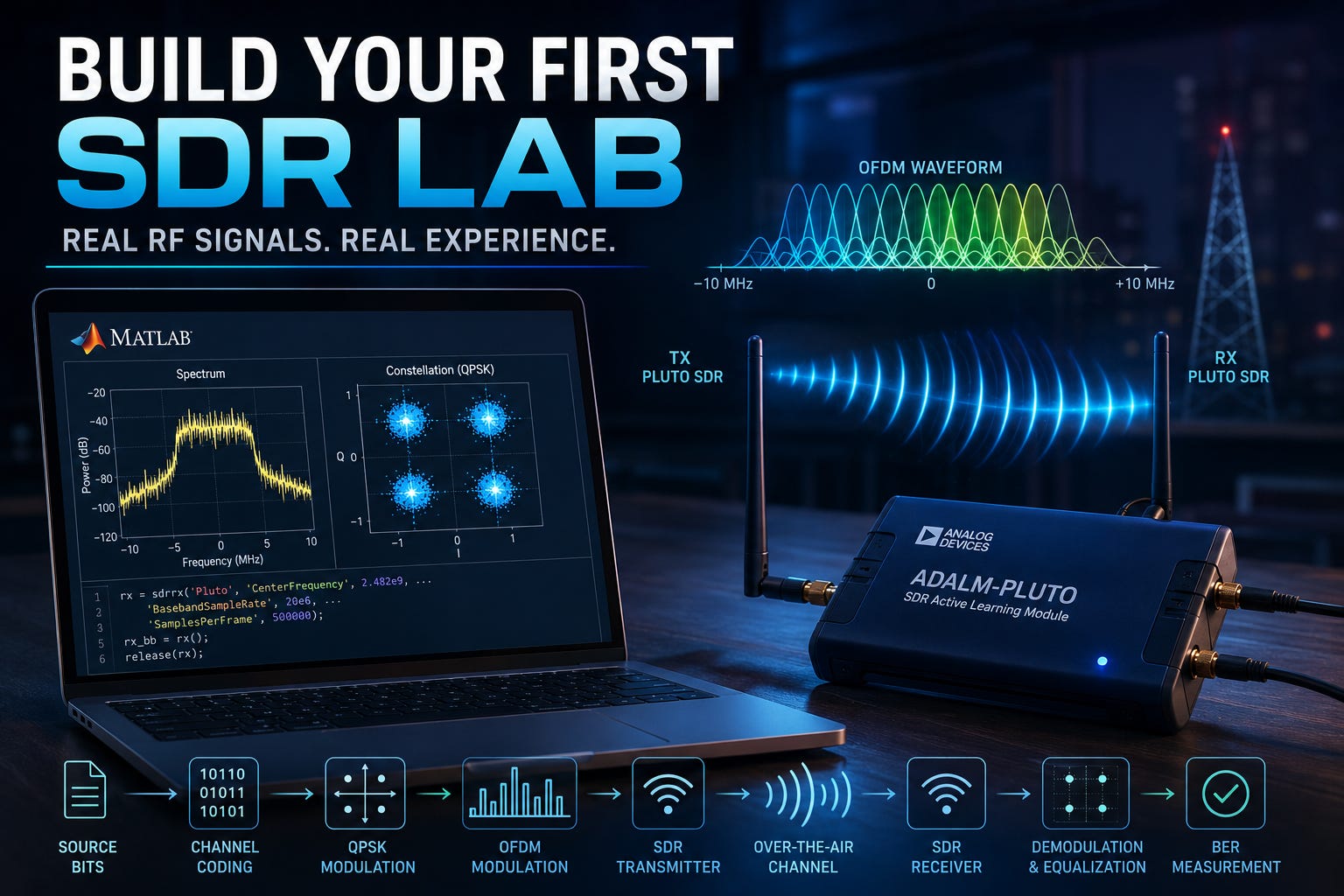
RF Systems 10.0: Building a Simple Software-Defined Radio (SDR) Setup That Demonstrates Real RF Skills - Part 1
Hello everyone! Welcome to another article in the RF Systems series!
If you are an RF engineer or a student pursuing engineering, you may already know that resumes are full of people who claim to understand RF systems. What separates you from the crowd is demonstrable, hands-on experience with real signals.
A Software-Defined Radio (SDR) setup costs between $25 and $300, fits on a desk, and lets you work with real over-the-air signals. This article walks you through building a credible SDR lab from scratch, performing experiments that map directly to RF engineering interview topics, and packaging that work so a hiring manager takes notice.
All code in this article is written in MATLAB, using the Communications Toolbox and the ADALM-PLUTO Support Package, the same environment used for serious SDR work in academic and early-stage product development. If one is more familiar with Python, the same work can be implemented in Python too!
Part 1 covers: hardware selection, toolbox setup, the system architecture, IQ sampling, the OFDM waveform structure, and the transmitter chain.
Part 2 covers: the receiver chain, synchronization, channel estimation, BER measurement, channel equalization, interference scanning, and portfolio packaging.
Let’s Dive in!