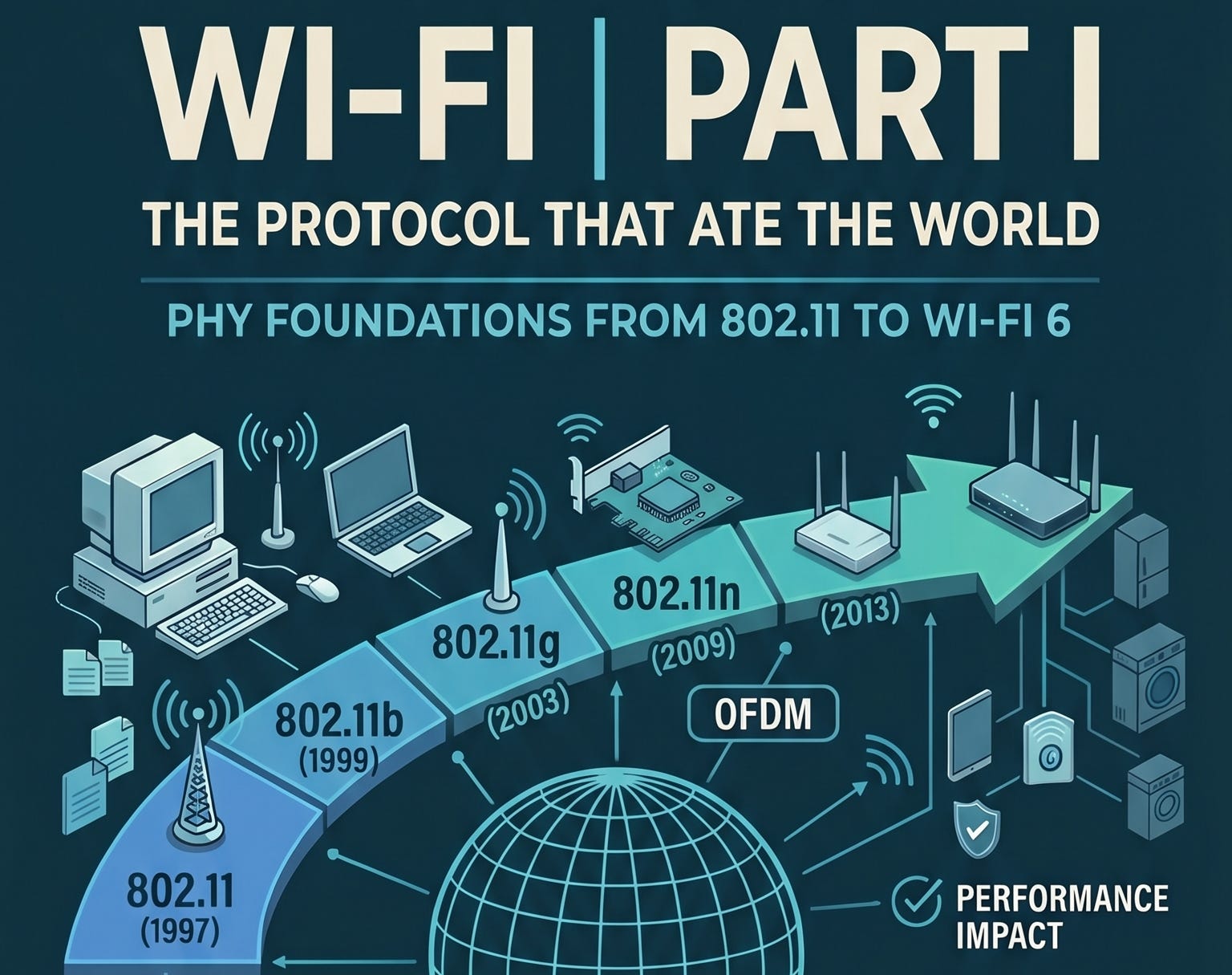
RF Systems 5.0: Wi-Fi, Part I — The Protocol That ate the World (PHY Foundations from 802.11 to Wi-Fi 6)
From a Hawaiian packet radio experiment to 19 billion devices: how Wi-Fi's physical layer became the most important radio standard in human history.
The Accidental Empire
In 1971, a University of Hawaii professor named Norman Abramson did something audacious: he connected seven computers across four islands using radio packets instead of telephone lines. ALOHAnet wasn’t elegant—nodes just transmitted whenever they had data, collided constantly, and retransmitted after random backoffs. It worked anyway, and it accidentally invented the conceptual foundation for every shared-medium network that followed: Ethernet, Wi-Fi, even the cellular uplink.
Twenty-six years later, in 1997, the IEEE ratified 802.11—a 2 Mbps wireless LAN standard that nobody expected to matter much. Bluetooth was the darling of consumer wireless. Ethernet owned the enterprise. Wi-Fi was a curiosity for hospital carts and warehouse scanners.
Then Steve Jobs put an AirPort card in the iBook in 1999, and the world quietly tilted on its axis.
Today, Wi-Fi carries more than half of all internet traffic globally. There are roughly 19 billion Wi-Fi devices in active use—more than people on Earth. The IEEE 802.11 working group has shipped a new amendment roughly every 2-3 years, each one squeezing more bits out of the same crowded spectrum through increasingly clever signal processing.
The philosophy of Wi-Fi is the opposite of Zigbee’s. Where Zigbee said “sacrifice throughput for longevity,” Wi-Fi said “sacrifice everything for throughput.” And then, generation after generation, refused to sacrifice anything else either.
Let’s dig in.