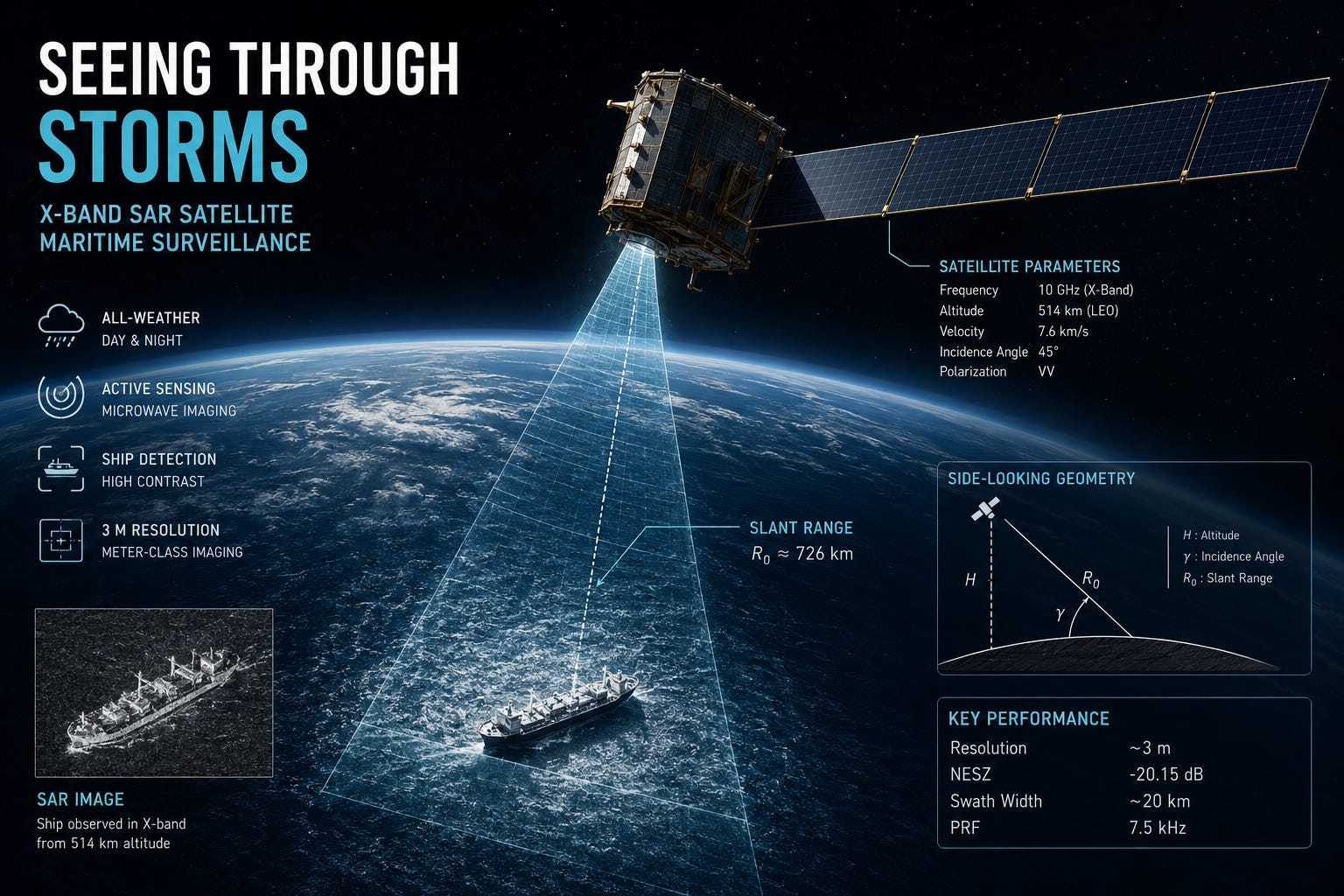
RF Systems 4.0: Designing an X-Band Synthetic Aperture Radar (SAR) Satellite for Maritime Surveillance
How synthetic aperture radar is transforming satellites into intelligent all-weather imaging systems.
Hello everyone! Welcome to another article on the RF Technology series.
Today’s topic: Synthetic Aperture Radar design
At first glance, the ocean looks empty when seen from space.
But hidden beneath clouds, storms, darkness, and thousands of kilometers of open water is one of the most complex traffic systems on Earth. Cargo ships move trillions of dollars in trade. Fishing vessels operate across disputed waters. Smugglers exploit blind spots. Naval fleets disappear into weather systems.
And yet, from 500 kilometers above Earth, a radar satellite can still see them. But this is not with a camera! This is where the idea of radar, or more specifically, a Synthetic Aperture Radar (SAR), comes into place.
Our recent project explored the design of an X-Band SAR system capable of imaging maritime vessels from Low Earth Orbit (LEO). What started as a radar engineering exercise quickly became something deeper: a study of how modern satellites bend signal processing, electromagnetics, orbital mechanics, and RF engineering into a machine that can effectively “paint” images using microwaves.
This is the story of that system, and why radar may be one of the most fascinating technologies humanity has ever built.